
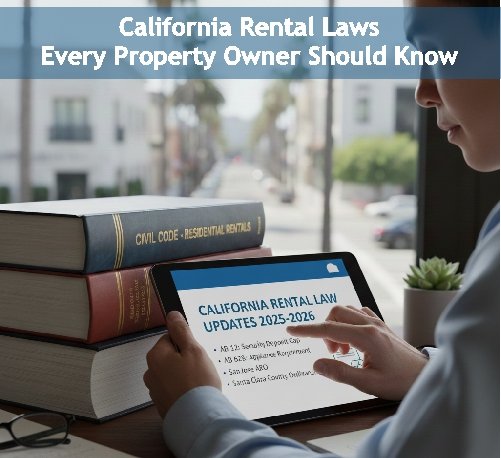
Summary: California rental laws change frequently, and Santa Clara County adds its own compliance layers. This guide covers state baselines, local rent caps, security deposit limits, and eviction procedures so property owners can protect their investments and avoid costly disputes.
Why California Rental Law Compliance Matters in 2025
California rental laws are constantly changing, and 2025 brings critical updates that affect property owners across San Jose and Santa Clara County. Recent changes include AB 12’s one-month security deposit cap (effective July 2024) and the upcoming AB 628 appliance requirement. Missing these updates can cost you thousands in tenant disputes, regulatory penalties, and legal defense fees.
San Jose’s Apartment Rent Ordinance, Santa Clara County’s Tenant Protection Ordinance, and city-specific programs create a complex compliance map. Property owners managing multiple units or helping elderly family members with rental properties face the challenge of tracking which rules apply to each address.
San Jose property management professionals with decades of local experience monitor these updates and implement changes as part of their core service. Valley Management Group has managed residential rentals in Santa Clara County for over 40 years and builds compliance with local, state, and federal regulations into every lease, notice, and financial report.
Result for you: No surprise penalties, no last-minute scrambles to update leases, and no tenant disputes over outdated paperwork.
WHAT’S CHANGING IN 2026
Starting January 1, 2026, AB 628 requires most California rentals to include a working refrigerator and stove for leases entered into, renewed, or amended on or after that date. By written agreement, a tenant may provide their own refrigerator. Owners must replace any recalled appliance within 30 days. If your tenants currently provide their own appliances, budget for purchases now.
State Law Baseline Owners Must Meet
California’s Civil Code establishes minimum standards that apply to every residential rental. Understanding these baselines helps you meet legal obligations, avoid penalties, and maintain properties that attract quality tenants.
Habitability Requirements Every rental must provide a weatherproof structure, working plumbing and heating, adequate sanitation, safe electrical and gas systems, and freedom from health hazards. Beginning January 1, 2026, AB 628 requires owners to supply a working refrigerator and stove for new, renewed, or amended leases.
Action item: Budget for appliance purchases now if your units don’t already include them.
Security Deposit Limits (AB 12): Effective July 1, 2024, AB 12 caps most security deposits at one month’s rent. A limited exception allows certain small landlords (two or fewer properties and four or fewer units total, owned by natural persons/qualifying trusts/LLCs of natural persons) to collect up to two months’ rent. The majority of Santa Clara County rentals fall under the one-month limit. Owners must return deposits within 21 days of move-out, accompanied by an itemized statement for any deductions.
Why it matters: Exceeding the cap or missing the 21-day deadline can forfeit your right to any deduction and trigger penalties up to twice the deposit amount.
Refund and Accounting Timelines: Failing to provide a timely, detailed accounting can forfeit your right to any deduction and expose you to statutory penalties. Pre-move-out inspections give tenants a chance to cure defects and reduce disputes over deposit return.
Best practice: Schedule the inspection 10–14 days before lease end, document with photos, and provide a written deficiency list.
How VMG helps: Valley Management Group’s intake process ensures that lease agreements, deposit handling, and move-out procedures comply with Civil Code requirements—reducing the risk of claims, chargebacks, and statutory penalties.
Statewide Rent Caps and Just Cause (AB 1482)
AB 1482, California’s Tenant Protection Act, limits annual rent increases and requires just cause for most evictions. These rules apply statewide to properties built more than 15 years ago, with specific exemptions for single-family homes owned by individuals and condos where tenants received disclosure.
Rent Increase Formula: The law caps annual increases at 5% plus the local Consumer Price Index (CPI), not to exceed 10% total. For the Aug 1, 2025–July 31, 2026 period, Santa Clara County’s AB 1482 cap is 6.3% (5% + 1.3% CPI). Owners must verify the current year’s figure annually and provide proper notice.
Example: A $3,000/month rental can increase by up to $189/month under AB 1482 for 2025–26 (before checking local caps).
Just-Cause Eviction Requirements: AB 1482 divides eviction grounds into “at-fault” (nonpayment, lease violations, nuisance) and “no-fault” (owner move-in, substantial remodel, withdrawal from rental market). No-fault evictions require relocation assistance equal to one month’s rent and more extended notice periods. Documentation and proper notice format are critical; defective paperwork can delay proceedings by months.
Risk: One formatting error can add 2–3 months to an eviction and cost thousands in lost rent.
How VMG Helps: Valley Management Group calibrates rent increases to stay within both state and city caps, prepares compliant notices, and maintains the documentation trail needed in the event of disputes.
Result: No missed increase windows, no defective notices, and no revenue left on the table due to under-market rents.
City of San José Rules Owners Often Miss
San Jose imposes its own rent control and just-cause requirements that often exceed state law. Owners with properties inside city limits must comply with both frameworks, and the stricter rule always governs.
Apartment Rent Ordinance (ARO): San Jose’s ARO caps annual rent increases at 5% for covered units—apartments in buildings of three or more units built before September 1979. This cap applies regardless of the state formula, so ARO-covered units are limited to 5%. Owners of exempt properties should verify their status and keep exemption documentation on file.
Local Just-Cause Protections: San Jose’s local just-cause ordinance has its own coverage criteria and imposes specific notice requirements. The city provides dispute-resolution resources through the San Jose Rent Stabilization Program, which mediates conflicts and can penalize noncompliant owners.
Bottom line: San Jose’s rules can be stricter than state law—miss a notice requirement and face fines plus tenant claims.
How VMG Helps: Valley Management Group handles San Jose rent increase letters, ARO compliance verification, and all required documentation for owners. With over 40 years of experience in San Jose property management, we know which units are subject to ARO, how to structure compliant notices, and when to seek clarification from city staff.
Result: No ARO violations, no tenant disputes over improper notices, and professional relationships maintained throughout the tenancy.
Unincorporated Santa Clara County and City-by-City Differences
Santa Clara County’s rental rules vary by jurisdiction, and owners must confirm which ordinances apply to each property address.
County Tenant Protection Ordinance: Unincorporated areas of Santa Clara County follow the County’s Tenant Protection Ordinance, which mirrors many AB 1482 provisions but adds local enforcement mechanisms. Owners should check the County’s website for updates on coverage maps and exemption criteria.
City-Specific Programs: Neighboring cities maintain separate rent-stabilization and just-cause eviction programs. Mountain View has its own Community Stabilization and Fair Rent Act with distinct caps and procedures. Sunnyvale, Campbell, Cupertino, and other municipalities may adopt or modify rules independently.
Compliance challenge: If you own properties in San Jose, Mountain View, and unincorporated areas, you’re navigating three different rule sets—each with separate caps, notice requirements, and penalties.
How VMG Helps: The Santa Clara County property management services provided by Valley Management Group include address verification, ordinance lookup, and documentation of applicable local rules for every property you own. We map each property to the correct jurisdiction and apply the strictest rule set.
Result: You manage a portfolio across multiple cities without tracking three different ordinances, cap formulas, and notice windows.
Security Deposits, Inspections, and Move-Out Accounting
Security deposit disputes generate more small claims cases than almost any other landlord-tenant issue. Proper handling from move-in through move-out protects your deposit and your reputation.
One-Month Cap and Allowable Uses: AB 12’s one-month limit applies to most rentals as of July 2024 (with the limited small-landlord exception described above). Deposits can cover unpaid rent, cleaning beyond normal wear and tear, and repair of tenant-caused damage—but not ordinary wear and tear.
Common mistake: Withholding for normal wear and tear (faded paint, worn carpet from ordinary use) can trigger a tenant lawsuit and statutory penalties.
Pre-Move-Out Inspection Best Practices: California law allows tenants to request a pre-move-out inspection (typically two weeks before lease end). Conducting this walk-through, providing a written list of deficiencies, and giving tenants time to cure issues can prevent deposit claims and preserve goodwill.
Itemized Accounting Timelines: Owners have 21 days after move-out to return the deposit or provide an itemized statement with receipts or estimates for deductions. Missing this deadline forfeits your right to withhold any amount and can trigger penalties up to twice the deposit.
How VMG Helps: Valley Management Group’s standardized move-in/move-out checklist includes photo documentation, detailed condition notes, and pre-move-out scheduling.
Result: Fewer deposit disputes, faster turn times between tenants, and protected cash flow—without you coordinating inspections or tracking deadlines.
Eviction Procedures Overview and Timelines
California’s eviction process is highly procedural, and AB 1482’s just-cause requirements add documentation and notice layers.
Stakes: A single procedural error can add 2–4 months to an eviction and cost $10,000+ in lost rent and legal fees.
Common Notice Types: A 3-day notice addresses nonpayment of rent or curable lease violations. A 30-day or 60-day notice applies to no-fault terminations, with the more extended period required if the tenant has occupied the unit for a year or more. AB 1482 requires just cause for most notices, meaning owners must document the specific grounds and follow strict format rules.
Filing and Response Windows: If a tenant does not comply with the notice or vacate after the notice expires, the owner may file an unlawful detainer lawsuit. Tenants now have 10 court days to respond (effective January 1, 2025). Court calendars in Santa Clara County can extend the process by several weeks, and any procedural defect—improper service, missing just-cause documentation, incorrect notice period—resets the clock.
How VMG Helps: Valley Management Group coordinates with legal counsel and maintains all notices, service methods, and filings in compliance with local and state rules. Our 24-hour responsiveness ensures urgent issues are addressed before they escalate.
Result: No defective eviction filings, no cases dismissed on technicalities, and faster resolution when problem tenants must be removed.
Owner Compliance Checklist
Staying compliant across California’s rental law requires a systematic approach. Use this checklist to audit your properties and identify gaps before they become violations:
10-Point Compliance Checklist
- Unit habitability: Confirm working plumbing, heating, electrical, and weatherproofing; plan for 2026 appliance requirement (AB 628).
- Rent cap verification: Check current state CPI and local caps (ARO, county ordinances) before issuing increases.
- Deposit cap and receipts: Ensure deposits meet AB 12 limits; maintain itemized move-out statements and receipts.
- Required notices: Use compliant formats for rent increases, lease renewals, and just-cause terminations.
- City registration: Verify if your jurisdiction requires rental unit registration or business licenses.
- Renewal timing: Provide proper notice periods (30/60/90 days) per lease terms and local rules.
- Record-keeping: Retain lease documents, notices, inspection reports, and correspondence for at least three years.
- Vendor and maintenance: Use licensed, insured contractors; document repairs and safety inspections.
- Fair housing: Train anyone involved in tenant selection on protected classes and advertising compliance.
- Annual review: Schedule a yearly audit of lease terms, deposit handling, and ordinance updates.
How Valley Management Group Supports Owners
Valley Management Group is a full-service San Jose property management company that has managed residential properties in San Jose and throughout Santa Clara County for over 40 years. Regulatory compliance is built into every service: tenant screening, lease preparation, rent collection, maintenance coordination, and financial reporting. Our full-service model includes 24-hour emergency response, a vetted contractor network, and proactive monitoring of changes in local, state, and federal regulations.
For busy professionals managing multiple properties or families overseeing rentals for elderly parents, VMG’s hands-on approach provides peace of mind. Transparent monthly financial reports, digital communication tools, and expert guidance on pricing and compliance free owners from day-to-day stress while protecting long-term asset value.
Ready to simplify compliance?
→ Request a free property management quote—Valley Management Group currently offers one free month of service for new clients
Let 40+ years of local experience protect your investment and free your time.
Frequently Asked Questions
Q1: What is the security deposit limit in California? AB 12 caps most security deposits at one month’s rent, effective July 1, 2024. A narrow exception allows certain small landlords (as defined in the statute) to collect up to two months’ rent. The one‑month limit applies to the majority of rentals.
Q2: What is San José’s rent increase cap? San José’s Apartment Rent Ordinance limits annual increases to 5% for covered units—apartments in buildings of three or more units built before September 1979. This cap applies even if state law would allow a higher percentage.
Q3: Does Santa Clara County have its own rental ordinance? Yes. Unincorporated areas of Santa Clara County follow the County’s Tenant Protection Ordinance. Individual cities within the county (San Jose, Mountain View, Sunnyvale, etc.) maintain separate rent control and just-cause programs with distinct rules.